What does GMP temperature mapping for pharma and biotech involve?
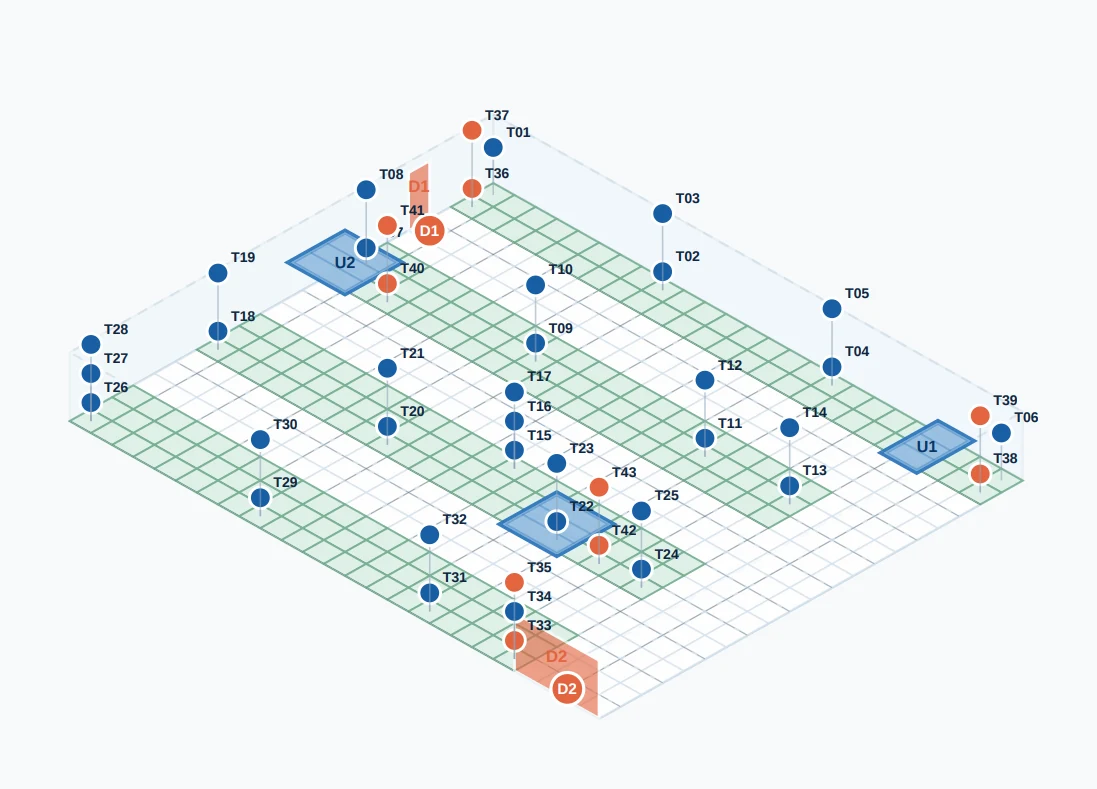
GMP temperature mapping is a documented qualification study that measures whether every product location and worst-case position inside a production room, climate chamber, cold room or freezer stays within its required temperature range over a representative period. The study identifies hot and cold spots, substantiates the representative loaded worst case, justifies the fixed monitoring probe position and alarm limits, and produces the OQ/PQ dossier that inspectors, MA-holders and Qualified Persons expect.
Is temperature mapping required under EU GMP?
Yes. EU GMP Annex 15 on qualification and validation requires documented evidence that facilities, systems and equipment consistently perform within established limits, and temperature mapping is the standard method to substantiate the OQ and PQ stages for temperature-controlled rooms and equipment. The revised EU GMP Annex 1 (in force since August 2023) adds strict expectations for HVAC performance and temperature control in classified areas. ICH Q9 (quality risk management) and Q10 (pharmaceutical quality system) frame periodic review, change control and CAPA around the mapping data. WHO TRS 961 Annex 9 (storage and transport of time- and temperature-sensitive pharmaceutical products), WHO PQS specifications and the ISPE Good Practice Guide: Controlled Temperature Chamber Mapping and Monitoring give the practical baseline for study design.
Should stability and climate chambers be mapped empty and loaded?
Yes. EU GMP Annex 15 and the ISPE Good Practice Guide: Controlled Temperature Chamber Mapping and Monitoring expect an empty-chamber study (typically part of OQ) to demonstrate intrinsic uniformity, followed by a loaded study (PQ) at representative product loading and configuration. For ICH Q1A(R2) stability chambers this means mapping at the declared condition, for example 25 °C / 60 % RH (long-term temperate), 30 °C / 65 % RH (intermediate or long-term for climatic zones III and IV) or 40 °C / 75 % RH (accelerated), with worst-case shelf loading, closed and briefly opened doors, and demonstrating recovery within acceptance criteria. Product locations that fall outside the qualified space cannot be used for stability samples.
How does temperature mapping fit into IQ, OQ and PQ under EU GMP Annex 15?
Temperature mapping is the OQ and PQ evidence in the Annex 15 qualification lifecycle. IQ verifies that the room, chamber or equipment is installed per specification and that instrumentation is calibrated and traceable. OQ demonstrates that the room or chamber performs to specification in the empty, unloaded state across the operating range and after simulated failures such as a power loss or door opening. PQ demonstrates that under real production loading, real operating hours and real routine use, all critical product locations stay within specification. The dossier explicitly traces acceptance criteria back to the URS and forward to the routine monitoring plan and alarm limits.
How often should a GMP cold room, climate chamber or freezer be re-mapped?
EU GMP does not fix a numeric interval; the frequency is defined in the Validation Master Plan on a risk basis per ICH Q9. Common practice is a full periodic re-mapping every 1 to 3 years for stable installations, with an annual documented review of the existing dossier in between. Any significant change triggers earlier requalification: HVAC modification, compressor or evaporator replacement, relocation, change in loading pattern, a repeated OOS, or a temperature excursion where root cause is not fully understood. The rationale for the chosen interval belongs in the qualification dossier and is challenged in every routine GMP inspection.
How is temperature mapping handled for a CMO or contract manufacturing site?
For a CMO or CDMO the mapping dossier serves two audiences at once: the site's own quality system and the MA-holder or sponsor's qualification file. In practice this means the URS and acceptance criteria are aligned with the product specification and the technical agreement, the mapping report is written to withstand both the CMO's internal QA review and the sponsor's audit, and any deviations trigger CAPA under joint change control. Temperature Mapping Europe delivers a report that both parties can file directly, without a rewrite for the sponsor.
What is the difference between monitoring and mapping in a GMP environment?
Monitoring runs continuously in daily operation, using one or a few fixed calibrated sensors that alarm when the room or equipment goes out of specification. Mapping is a one-off qualification study with many loggers on different positions over a representative period, executed under a protocol and reported under a signed OQ/PQ or requalification report. Mapping is what tells you where the monitoring probe belongs, which alarm limits protect the actual worst case, and what excursion behaviour to expect after a door opening or power interruption. Without mapping, monitoring positions and alarm limits cannot be defended in an inspection. See the
difference between monitoring and mapping for the full comparison.
How much does GMP temperature mapping for pharma cost?
Temperature Mapping Europe offers three fixed-price levels. Level 1 (from €299) is self-execution with rented calibrated data loggers, for teams with their own protocol. Level 2 (from €599) means we prepare the mapping protocol upfront and deliver the analysis report with the mapping data afterwards, while your team places the loggers and runs the measurement on site. Level 3 (from €999) is complete on-site execution, where the mapping is performed, analysed and documented under our protocol. These prices are typically well below what larger validation consultancies quote for the same scope, because we work as a focused specialist team without the overhead of a large consultancy.
When is temperature mapping required in a pharma or biotech facility?
Mapping is required for commissioning a new GMP facility, production room, climate chamber or cold room, after HVAC modification or relocation, under change control that affects temperature control, when preparing for an EMA, FDA or MHRA inspection or a customer audit, for periodic requalification per the Validation Master Plan, after a temperature deviation or OOS with unclear root cause, when onboarding a CMO or transferring a site, and for qualification of ICH stability chamber storage or a new stability programme.