What does temperature mapping for a pharmacy refrigerator involve?
Temperature mapping for a pharmacy refrigerator is a documented study of the temperature distribution inside the fridge. Over a representative period of at least 72 hours, including a busy opening-hours cycle, it identifies the warmest and coldest positions, shows whether they stay within 2-8 °C, and justifies where the routine monitoring probe should sit. The result is the audit-ready dossier that pharmacy inspection visits expect. The same method extends to stockrooms and dispensing automats for ambient storage.
Is temperature mapping required for pharmacies?
No single EU regulation names temperature mapping as mandatory for community or hospital pharmacies, but every European jurisdiction expects that medicine storage is demonstrably suitable. Pharmacy inspection reports return to the same requirement: temperature monitoring of storage areas, pharmaceutical refrigerators, pharmacy stock robots and dispensing automats must be demonstrably operational. In the Netherlands, the pharmacy Practice Guideline (Richtlijn Praktijkvoering section 2.4.2.5 and note 23) requires demonstrable control of storage temperature; in practice, a temperature mapping study is the accepted way to substantiate this. Comparable national pharmacy standards apply elsewhere in the EU.
How many measurement points does a pharmacy refrigerator need?
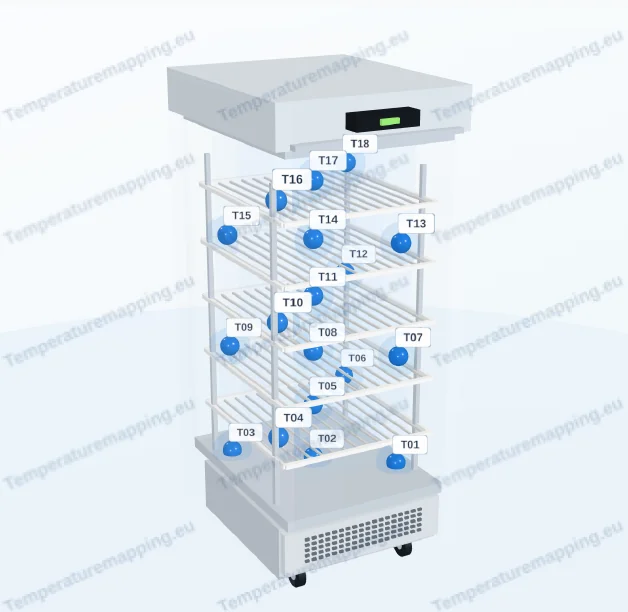
For a typical upright pharmacy refrigerator we usually place between 9 and 18 loggers, distributed across shelves, near the door, along the back wall and close to the evaporator plate. The lower bound follows the WHO PQS baseline of at least 9 measurement points for storage volumes up to about 2 m³; larger fridges, walk-in cold rooms and ward medicine rooms scale up from there. The exact number depends on volume, shelf configuration (e.g. wired shelves with good circulation compared to closed shelves with poor air circulation), and is documented in the mapping protocol.
Where should the fixed monitoring probe sit inside the fridge?
The monitoring probe should sit where the mapping data identify the worst-case position, so a routine alarm triggers before any product location goes out of specification. For a pharmacy refrigerator that can be the warmest spot during the morning peak, the coldest spot near the evaporator plate when the risk is freezing of biologics, or in some cases both, with two probes. Another position is only defensible when the mapping data justify it. The principle, in line with EU GDP and ISPE Cold Chain guidance, is that the choice is data-driven and documented, not the position the manufacturer happened to pick.
How often should a pharmacy refrigerator be re-mapped?
European regulations do not fix an interval for re-mapping a pharmacy refrigerator. In practice, a full re-mapping is typically repeated every 2 to 3 years for a stable installation, with an annual paper review of the existing dossier in between. Any significant change triggers earlier re-mapping: thermostat replacement, moving the fridge, a changed loading pattern/shelves or unexplained deviations picked up by routine monitoring.
How long does a pharmacy temperature mapping study take?
The measurement itself typically runs for at least 72 hours for a pharmacy refrigerator. For an ambient stockroom the measurement extends to at least one full week including a weekend. Temperature Mapping Europe can move quickly: with the protocol upfront (3 to 5 working days) and the analysis and dossier afterwards (5 to 10 working days), the total lead time from intake to delivered dossier is typically 2 to 3 weeks. Level 1 self-measurement can move faster, but delivers no external analysis or report.
How much does temperature mapping for a pharmacy cost?
The cost of temperature mapping for a pharmacy depends on the scope and how much your team performs. Temperature Mapping Europe offers three service levels: from €299 for calibrated logger rental (Level 1), from €599 for a protocol upfront and analysis report afterwards with your team placing the loggers on site (Level 2), and from €999 for complete on-site execution (Level 3). When multiple units of the same type, such as several pharmacy refrigerators, are mapped in the same visit, we can offer a more favourable rate because the same protocol carries across them.
What is the difference between temperature monitoring and temperature mapping in a pharmacy?
Temperature monitoring and temperature mapping answer different questions. Monitoring runs continuously in daily operation, using one or a few fixed sensors that alarm when the fridge or stockroom goes out of specification. Temperature mapping is a one-off study with many loggers on different positions over a representative period; it identifies where inside the space the warmest and coldest points sit, and justifies where the monitoring sensor should be placed to catch excursions first. In short: mapping is what tells you where monitoring belongs. See the
difference between monitoring and mapping for the full comparison.
Do dispensing automats and pharmacy robots also need temperature mapping?
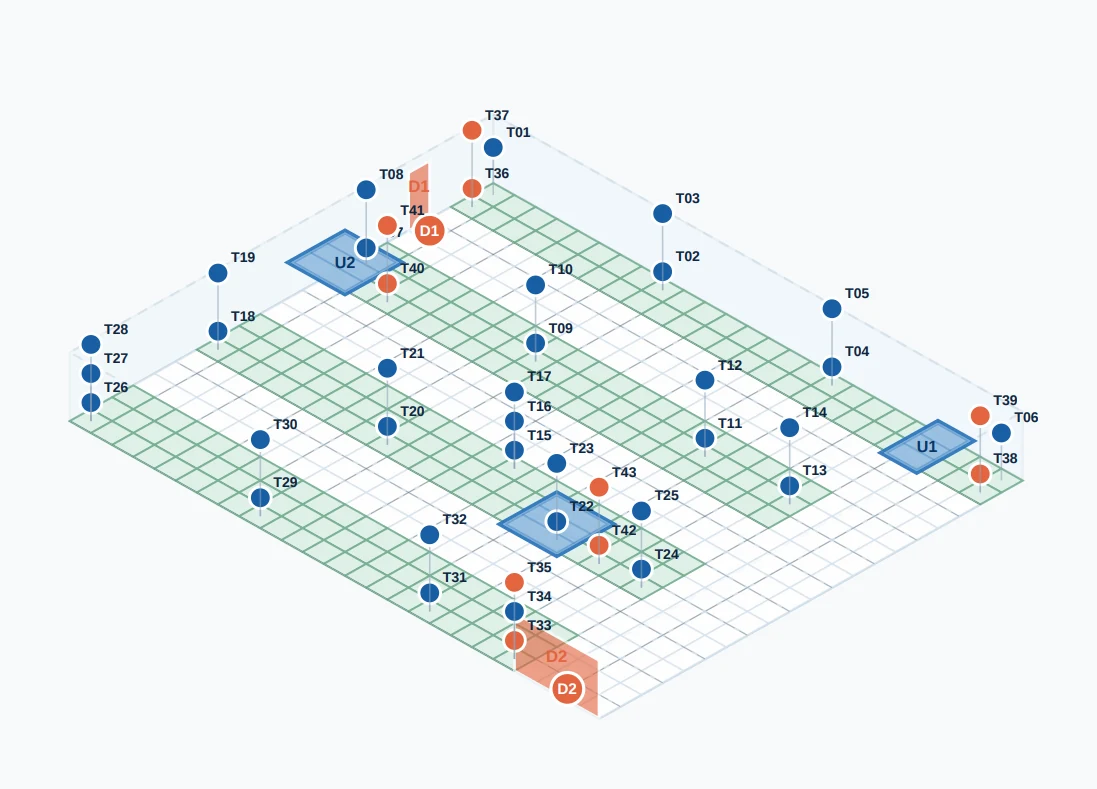
In principle yes, and pharmacy inspection reports explicitly ask for it. A dispensing automat, whether a Rowa, Meditech, Willach or another brand, is a storage location: it has its own internal temperature zones, its own door and dispense-motor movement pattern, and its own sensor placement. Mapping shows whether the actual temperature inside the automat meets the required storage condition and whether the manufacturer's sensor is representative. For an automat with a refrigerated compartment, the study covers both the ambient section and the 2-8 °C section. In practice the loggers are placed in dead-zones or on fixed positions where the robot cannot mistake them for stock.