Why transport is the weakest link in the cold chain
A cold room stands still. Its doors open at predictable moments and its ambient conditions change slowly. A vehicle faces summer sun on the roof, winter frost on the road, an engine that is switched off during a delivery, and a door that opens at every drop. On top of that, transport often passes through several hands: shipper, forwarder, carrier, subcontractor and receiver.
Most temperature-controlled trucks, trailers and containers were never designed to meet GMP requirements, and commercial carriers do not always maintain the training, procedures, change control and deviation handling that GMP expects. From a quality perspective, the temperature of the transport environment should therefore not simply be relied upon. That is the reason transport qualification exists: it replaces trust with evidence.
The regulatory anchor for European distributors is EU GDP (2013/C 343/01), chapter 9. It expects storage conditions to be maintained during transport, a risk-based approach to transport planning, qualified equipment for temperature-sensitive products and, where refrigerated vehicles are used, temperature mapping under representative conditions that takes seasonal variation into account. The rest of this article explains how to do that in practice.
Qualification or validation? The terms in transport
In transport the words are often used interchangeably. Qualification is documented testing that demonstrates, with a high degree of assurance, that a specific process will meet its predetermined acceptance criteria. Validation is documented testing under highly controlled conditions that demonstrates processes, methods and systems consistently produce results meeting predetermined acceptance criteria. A practical way to keep them apart: you qualify the equipment (the vehicle, the container, the packaging), and you validate the transport process that uses it (loading pattern, route, stops, handovers and procedures). Both a classic commissioning and qualification approach and a science- and risk-based approach are valid, as long as the choice is documented and proportionate to the risk.
| Element | What it demonstrates | Typical evidence for a refrigerated truck |
|---|---|---|
| Route profiling | Which ambient conditions, durations, stops and handovers the product will actually meet. | Weather data for the routes, planned stops and number of drops, data from earlier shipments. |
| Equipment qualification (IQ, OQ) | The vehicle as built can hold its set point throughout the load space and behaves predictably under stress. | Identification of body and unit, insulation and refrigeration capacity, calibrated sensors, static temperature mapping, door-opening and failure tests. |
| Process qualification or validation (PQ) | Vehicle, load pattern, route and procedures together keep the product in range, repeatably. | Field shipment tests at maximum and minimum payload in the warm and the cold season, with loggers inside the product packaging. |
| Ongoing verification | The qualified state is maintained in routine operation. | Monitoring at worst-case positions for every shipment, yearly calibration, alarm checks, periodic data review and requalification after changes. |
What EU GDP and WHO expect
The two frameworks do not contradict each other; they operate at different levels of detail. EU GDP states what must be achieved, and WHO Annex 9, together with WHO Technical Supplement 11, turns that into concrete requirements and test methods.
| Topic | EU GDP 2013/C 343/01 | WHO Annex 9 and Supplement 11 |
|---|---|---|
| Sea and air freight | Outsourced transport requires a written contract; the supplying distributor remains responsible for keeping conditions within limits during transport. | Carriers contracted for air or sea transport operate under a formal service level agreement that makes them responsible for load temperatures within the transport temperature profile of each product. |
| Refrigerated road vehicles | Temperature-sensitive products travel in qualified equipment; for refrigerated vehicles, temperature mapping under representative conditions including seasonal variation. | Qualify each owned or operated vehicle before it becomes operational; vehicles of common carriers must also be qualified, with responsibilities set out in the agreement. |
| What the qualification shows | Mapping under representative conditions, taking seasonal variation into account. | Temperature distribution for commonly used load layouts at the ambient extremes of known routes, zones not to be loaded, and time to exceed limits when the unit fails. |
| Routine monitoring | It must be possible to demonstrate that products were not exposed to conditions that compromise their quality; deviations are reported to distributor and recipient. | Monitoring sensors accurate to ±0.5 °C at worst-case positions, at least six readings per hour, transit temperatures documented for every shipment. |
| Calibration and alarms | Temperature monitoring equipment in vehicles and containers maintained and calibrated at least once a year. | Control and monitoring devices calibrated against a traceable reference at least once a year, alarms checked at least once a year. |
| Requalification | Follows from the risk-based approach to transport and from change control in the quality system. | After significant modifications to the vehicle; consider it when monitoring shows unexplained variability greater than normal. |
Sea and air freight: the quality agreement does the heavy lifting
For sea and air freight, qualifying the equipment yourself is rarely realistic. You do not own the reefer container or the aircraft hold, the cargo passes through ports, airports and customs, and the conditions differ per vessel, per flight and per handling agent. Two flights on the same route can produce very different temperature records. Typical risks are pallets left on the tarmac, customs inspections in which packages are opened, and temperature control on the aircraft that does not match the product. After arrival, shipments should be moved to temperature-controlled storage as soon as possible and cleared through customs quickly.
That is why companies usually contract a specialised forwarder or carrier and secure the temperature requirements in a quality and technical agreement (QTA). Under that agreement, the carrier is made responsible for maintaining load temperatures within the transport temperature profile of each product. The qualification of the reefer containers, active air containers and handling facilities sits with the carrier and its partners. Your job is to select them carefully, fix the requirements in writing and verify performance with data.
A QTA for temperature-controlled sea or air freight typically covers:
- The transport temperature range per product, the set point, and the acceptable excursions supported by stability data.
- Qualification evidence for the equipment used: reefer containers, active air containers or qualified passive packaging.
- Which lanes, transit times and handover points are covered, and how temperature is controlled during dwell times and customs clearance.
- Temperature monitoring per shipment: who supplies the loggers, where they are placed, and who reads out and retains the data.
- Alarm set points, excursion reporting timelines, and who decides on the product.
- Calibration and maintenance of the carrier's equipment, and access to those records.
- A flow-down clause: subcontractors are bound by the same terms, and no subcontracting without prior approval.
- Change notification for equipment, lanes and quality systems, and audit rights.
A QTA does not make temperature mapping irrelevant for these shipments. The legs before and after the port or airport usually run by road, often in a refrigerated truck. And the staging and dispatch areas at your own site, where pallets wait before pick-up, are temperature-controlled areas that should be kept within the product range and monitored while products are handled. Those are the places where your own mapping evidence starts.
Refrigerated trucks and vans: where temperature mapping does the work
Road transport is different. Refrigerated vans and trucks are often owned by the distributor or operated as a dedicated fleet by a contract carrier. The load compartment behaves like a small, long and narrow cold room, so qualifying a refrigerated vehicle is essentially a temperature mapping exercise, similar to mapping fixed temperature-controlled storage.
The risks that the mapping has to capture are specific to vehicles:
- Freezing at the front. The coldest air leaves the unit at the front, just below the roof. Products for 2-8 °C in that air stream can drop below 2 °C. The qualification should therefore define zones where no product may be loaded, for example close to cooling coils or in cold air streams.
- Warm air at the doors. On multi-drop routes the rear or side doors open many times. Products just inside the doors warm up first.
- Blocked airflow. Air delivered along the ceiling has to return along the floor. Overloading and "wall-loading" restrict that airflow, so a vehicle loading plan SOP should secure enough clearance.
- Engine off. Many van units are driven by the engine. A vehicle has to maintain its range not only in motion, but also when parked with the main engine stopped.
- Seasons. Solar load on the roof in summer, and in winter the risk that 15-25 °C products fall below range. In cold climates the vehicle needs low-temperature protection, and heating capacity whenever the compartment has to stay above 0 °C.
- The cab display is not the load. The control sensor sits in the return air stream, independent of the monitoring system. The display shows mixed return air, not the warmest box near the door.
An ATP certificate is useful but is not a pharmaceutical qualification. ATP (the UN agreement for the carriage of perishable foodstuffs) classifies insulation and refrigeration capacity. Those figures are useful as installation checks: an insulation coefficient of at most 0.7 W/m²K for chilled and 0.4 W/m²K for frozen transport, with below 0.4 W/m²K recommended for new vehicles, and refrigeration over-capacity of at least 1.75 times the heat ingress at +30 °C ambient (2.25 in hotter climates). But ATP equipment is only fit for purpose where it aligns with the acceptance criteria of the product, and ATP says nothing about the temperature distribution with your load pattern on your routes. That is what the mapping shows.
Step by step: qualifying a refrigerated vehicle
The programme below is based on the WHO guidance for refrigerated road vehicles and the ISPE Cold Chain Management guide. It follows the familiar qualification stages (see IQ, OQ and PQ for temperature mapping), translated to a vehicle.
Step 1: requirements and route risk assessment
Before anything is measured, define what the vehicle must do. Typical inputs are the modes of transport, handling methods, available power sources en route, product conditions, range of shipment sizes and weights, environmental conditions, and minimum and maximum transit times. In practice, write down:
- Product temperature ranges carried (for example 2-8 °C, 15-25 °C, or both in separate compartments).
- Load layouts in routine use: full pallets, roll cages, totes, partial loads, double stacking.
- Routes: the longest route, the route with the most drops, overnight parking, border crossings.
- Door-opening pattern per drop, and whether the engine is switched off during deliveries.
- The ambient extremes expected over the year, based on weather data for the routes.
This is also the route risk assessment that EU GDP expects. It tells you which scenarios are worst case, and it prevents the test programme from missing the one route where things actually go wrong.
Step 2: installation qualification (IQ)
IQ confirms the vehicle is what it should be and ready for testing. Check at least:
- Unique identification of both the insulated body and the refrigeration unit from the manufacturer's plates: country of manufacture, manufacturer, model, serial number, year and month of manufacture.
- Insulation and refrigeration capacity against the specification (ATP data), and a performance check according to the maintenance procedure.
- Calibrated control and monitoring sensors, accurate to ±0.5 °C, with the control sensor in the return air stream and independent of the monitoring system.
- Alarms that alert the driver to temperature excursions or unit failure, and security seals or locks on the doors.
- Maintenance and cleaning records in place.
Step 3: operational qualification (OQ) with a static mapping
Start with a static temperature mapping before the mobile tests, to find the worst-case positions: the hottest and coldest spots in the load compartment. Those positions then carry loggers during the field tests. For a temperature-controlled truck, static external summer and winter conditions can be used as worst case, provided the choice and the impact of variations are understood.
- Static mapping. Precondition the compartment, load a representative (or simulated) load, and place loggers in cross-sections from the unit to the doors, at low and high positions and near both walls. Run long enough to capture stable operation, unit cycling and defrost. In our practice that is several hours up to 24 hours, depending on how the vehicle is used.
- Door-opening test. Simulate the door-open times and frequency from step 1. This validates the door-opening times expected during deliveries. Use a short recording interval: 15-minute readings give insufficient data for open-door tests, and intervals of 1 to 5 seconds suit such short events.
- Engine-off or standby test. Where the unit depends on the engine or on shore power, test what happens during a delivery stop or overnight parking.
- Alarm verification. Verify that the alarms work and that the set points of the unit are correct.
Step 4: the temperature-control failure test (hold time)
You also need to demonstrate how long it takes for temperatures to exceed the limits when the refrigeration unit fails. The test works as follows:
- Never use real product; use expired product after a risk assessment, a substitute with similar thermal properties, or empty boxes. Use a minimal payload, because the lowest thermal mass is the worst case.
- Precondition the compartment, set the unit to the middle of the range (for example +5 °C for 2-8 °C products) and let the load stabilise, which takes about 12 hours.
- Switch the unit off. The test ends when the first product temperature exceeds the maximum or minimum.
- Test at the heat and cold extremes likely to occur in service.
There is no pass or fail. The recorded time is used to set contingency procedures and response times, and feeds the emergency plan for vehicle breakdowns. A driver who knows the vehicle has, for example, a two-hour margin in summer can act on it.
Step 5: performance qualification (PQ) with field shipment tests
The field tests show that vehicle, load and route work together in reality. WHO Supplement 11 sets a minimum of four tests:
| Test | Payload | Season | What it challenges |
|---|---|---|---|
| A | Maximum | Warmest | Airflow through a full load and heat removal capacity. |
| B | Minimum | Warmest | Low thermal mass, fast warming at the doors. |
| C | Maximum | Coldest | Uneven distribution in winter, freezing near the unit. |
| D | Minimum | Coldest | Low thermal mass combined with low ambient: undercooling or freezing. |
- Use real product during a live delivery, or expired or dummy product with similar thermal properties, mass and packaging.
- Fix the probes inside the product packaging, so you record product temperature rather than air temperature. Cover at least the most vulnerable positions from the static mapping.
- Choose a worst-case route: multiple drops with door openings, the shortest time between drops, and overnight stops on electric standby.
- With several drops, at least two probes covering the hottest and coldest locations must stay with the payload until the final drop.
- Repeat runs where needed to demonstrate reproducibility; a minimum of three runs is common practice for shipping PQ.
Because the tests span two seasons, a vehicle can only be provisionally qualified after the first two tests and is fully qualified once the second pair has passed, which may take up to six months. Where a test chamber is available, both seasons can be simulated in a static exercise.
Step 6: acceptance criteria, report and release
WHO Supplement 11 requires product temperatures to stay within range during the entire route and across all four tests. Its example for 2-8 °C allows the ±0.5 °C accuracy of the logger on top of the range. Many QA teams take the more conservative route and apply that accuracy as a guard band inside the range, as explained in acceptance criteria and measurement uncertainty. Either choice is defensible, provided it is fixed in the protocol before the first test.
The qualification report should give:
- The vehicle identification, test conditions per test (payload, season, route, ambient range) and deviations from the protocol.
- Hot and cold spots, and the no-go zones where product may not be loaded.
- Maximum door-open time, hold time after unit failure and engine-off behaviour.
- The routine monitoring positions and input for the loading plan SOP (clearances, double stacking only if validated).
- The qualification status: provisional, full, or failed with the reasons and recommended actions.
See our protocol versus report article for how the two documents fit together.
Step 7: routine monitoring and requalification
After qualification, monitor at the worst-case positions with at least six readings per hour and document transit temperatures for every shipment. Review the monitoring data periodically, to spot degrading equipment and problematic routes before they become excursions. Requalify after significant modifications, such as a new or replaced refrigeration unit, body repairs, new bulkheads or air ducts, or a change of set point, and consider requalification when monitoring shows unexplained variability. Calibrate monitoring devices at least once a year and check alarm functions at least once a year. For triggers in fixed storage, see how often mapping should be repeated.
How many loggers, and where, in a refrigerated vehicle?
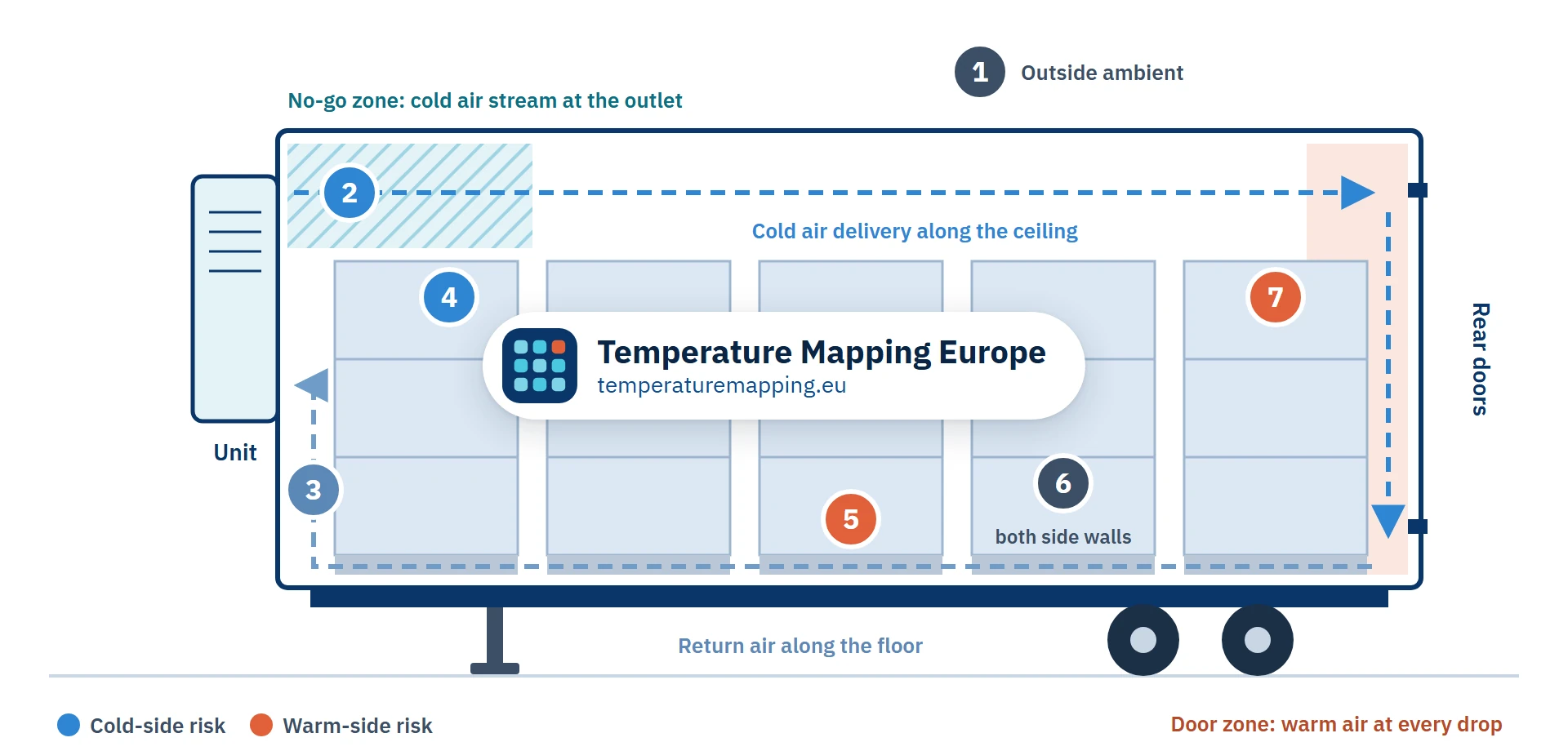
WHO Supplement 11 (Annex 1) lists the minimum recording requirements for a qualification test: the locations that must at least be covered. These are types of location, not a logger count. A single requirement such as "product close to the walls" or "product close to the door" usually takes several loggers, and the example layout in the supplement spreads loggers over the whole load. Ideally, probes are spread throughout the load, with the most vulnerable locations as the minimum. The numbers in the table match the figure above.
| # | Location | What it tells you |
|---|---|---|
| 1 | Outside ambient, around the external surfaces | Links every internal reading to the conditions the vehicle actually faced, and shows whether the test really reached the intended seasonal extreme. |
| 2 | Air delivery of the refrigeration unit | The coldest air in the compartment; shows set point behaviour, defrost cycles and freezing risk. |
| 3 | Return air of the refrigeration unit | Close to what the control sensor sees; comparing it with product positions shows the offset between the cab display and the load. |
| 4 | Product close to the delivery air | Freezing risk for 2-8 °C products in the first section in front of the unit. |
| 5 | Product in areas likely to be deprived of airflow | Warm pockets between tightly stacked pallets, low in the middle of the load or behind bulkheads. |
| 6 | Product close to the walls | Heat ingress through the insulated body, including solar load on the sun-facing side. |
| 7 | Product close to the door | Warm air at every door opening; the most exposed position on multi-drop routes. Include side doors if the vehicle has them. |
The guidelines do not give a fixed number of loggers for a vehicle. A practical way to build the grid is to divide the load length into cross-sections from the unit to the doors and place five loggers per cross-section (four corners of the load plus the centre). The front section then covers the product near the delivery air, the rear section the product near the door, and the corners the walls; the centre positions pick up areas deprived of airflow. Add the air delivery, return air and outside ambient positions, and check that every location from the table above is covered.
| Vehicle | Cross-sections | Loggers in the load | Plus air and ambient | Typical total |
|---|---|---|---|---|
| Refrigerated van (load length about 2 to 4 m) | 2 (front, rear) | 10 | 3 | about 13 |
| Rigid truck (about 6 to 8 m) | 3 (front, middle, rear) | 15 | 3 | about 18 |
| Semi-trailer (13.6 m) | 4 to 5 | 20 to 25 | 3 | about 23 to 28 |
These totals are starting points from our practice, not a regulatory number. Treat each temperature compartment of a multi-temperature vehicle as a separate space, add loggers for side doors or bulkheads, and justify the final plan in the protocol. The same reasoning for fixed storage is in how many measurement points are needed and where to place data loggers.
For routine shipments the number drops sharply. The number of monitors in regular shipments follows from the qualification results, and depends on mode of transport, volume, number of pallets and product value. In a qualified vehicle that usually means monitoring at the worst-case positions found during qualification, rather than a full grid.
Fleet approach: type qualification plus IQ per vehicle
A distributor with thirty identical vans does not have to run the full programme thirty times. WHO accepts an alternative: a full qualification for each trailer and refrigeration unit type, combined with an installation qualification for each individual vehicle when it enters service.
The weak point is the definition of "the same type". In our experience it is only defensible when body builder, internal dimensions, insulation specification, refrigeration unit model, air duct or chute, door configuration and bulkhead layout are identical. A different unit, an extra side door or a changed partition makes it a different type. Many QA teams also add a short static check on each new vehicle, which costs little and quickly exposes a unit that was set up differently.
Contract carriers: who qualifies the trucks?
Outsourcing transport does not outsource the question. WHO is explicit here: vehicles of a contract carrier must be qualified, with the responsibilities set out in the agreement, and the shipper has a duty to ensure they are. In practice that means:
- Ask for the carrier's qualification reports and check that they cover your load layouts, your routes and both seasons.
- Check the transport vehicle and its conformity with the agreement before loading.
- Put your own loggers in the load, at least until performance is proven, and review the data at receipt.
- Audit the carrier's quality system; an audit combined with a quality agreement can reduce the level of routine verification you need.
- Where the carrier cannot show adequate qualification, arrange the mapping of the dedicated vehicles yourself or together with the carrier.
Where our services fit
Temperature Mapping Europe works brand-neutrally and supports transport qualification at the level of work you want to keep in-house. The technical requirements do not change with the route you choose: loggers calibrated, positions justified, criteria fixed in advance, results traceable.
- Map your own vehicles with rented loggers. Our data logger rental sets contain calibrated loggers (−40 °C to +85 °C, so 2-8 °C, 15-25 °C and frozen transport are covered), calibration certificates and mounting material. Field tests fit this model well: your drivers run the real routes, and you receive a paginated data report and Excel export afterwards.
- Protocol and report. With our audit-ready protocol and report we write the transport qualification protocol (requirements, route risk assessment, logger plan per vehicle type, test matrix and acceptance criteria) and turn your data into the report with hot and cold spots, no-go zones, hold time, monitoring positions and input for the loading plan.
- Full execution. We carry out the static mapping, door-opening and hold-time tests at your depot, prepare the logger kits and instructions for the field tests, and deliver the qualification dossier. See our services.
- Review of existing documents. Already have mapping reports from your carrier, or temperature clauses in a QTA? We review them point by point against the applicable guidelines.
- The fixed links in the chain. Dispatch areas, cold rooms at 2-8 °C and GDP warehouses are where every shipment starts and ends.
Common misconceptions
- "The truck has an ATP certificate, so it is qualified." ATP classifies insulation and refrigeration capacity. It does not show the temperature distribution with your products, your load pattern and your routes.
- "The display in the cab reads 5 °C, so the load is fine." The control sensor sits in the return air. The box next to the door or in the cold air stream can be well outside that reading.
- "With a QTA, the carrier carries the responsibility." The agreement makes the carrier responsible for load temperatures, but under EU GDP the supplying distributor stays responsible for the product. You still need the data and the oversight.
- "One summer test is enough." After the warm-season tests a vehicle is only provisionally qualified; full qualification requires the cold-season tests as well.
- "Every vehicle needs a full mapping." A full qualification per vehicle type plus IQ per vehicle is an accepted alternative, provided the vehicles are genuinely identical.
- "Monitoring replaces qualification." Monitoring documents conditions but does not protect the product. The monitoring position only means something if the qualification showed it is the worst case.
- "The unit will cool the product down." Transport refrigeration is designed to maintain temperature, not to pull down warm product. Precondition the vehicle and load product at the correct temperature; a vehicle that was not preconditioned and doors left open too long during loading are typical causes of excursions.
Sources used
- WHO Technical Report Series No. 961 (2011), Annex 9: Model guidance for the storage and transport of time- and temperature-sensitive pharmaceutical products.
- WHO Technical Supplement 11 to TRS 961 Annex 9: Qualification of refrigerated road vehicles (May 2015).
- ISPE Good Practice Guide: Cold Chain Management (2011).
- EU Guidelines of 5 November 2013 on Good Distribution Practice of medicinal products for human use (2013/C 343/01).
- UNECE Agreement on the International Carriage of Perishable Foodstuffs and on the Special Equipment to be used for such Carriage (ATP).
Setting up a qualification file for vehicles and storage together? Also read what GDP requires for temperature mapping and what auditors want to see in a temperature-mapping study.
Sketch the logger grid for your load compartment
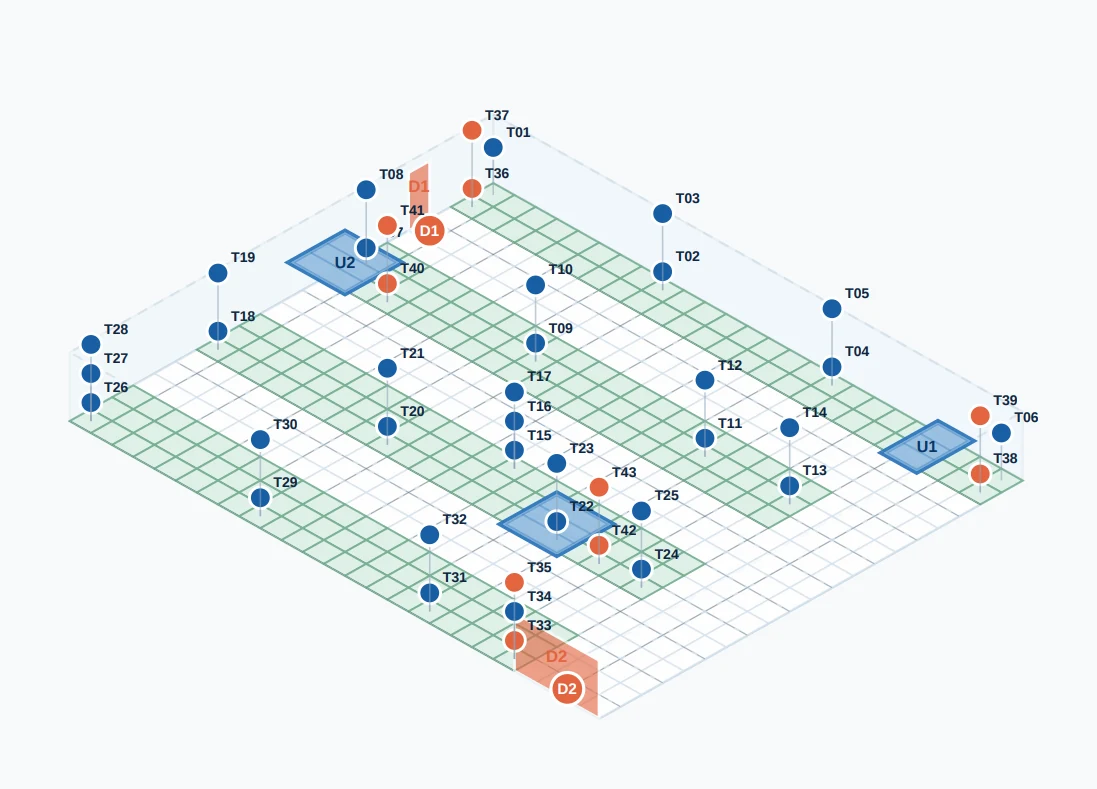
A load compartment is a long, narrow box. Enter its internal dimensions in the 3D mapping tool as if it were a small cold room to get a first grid of measurement points, then add the transport-specific positions: air delivery, return air, doors and outside ambient.
Start the 3D mapping tool