What each letter means
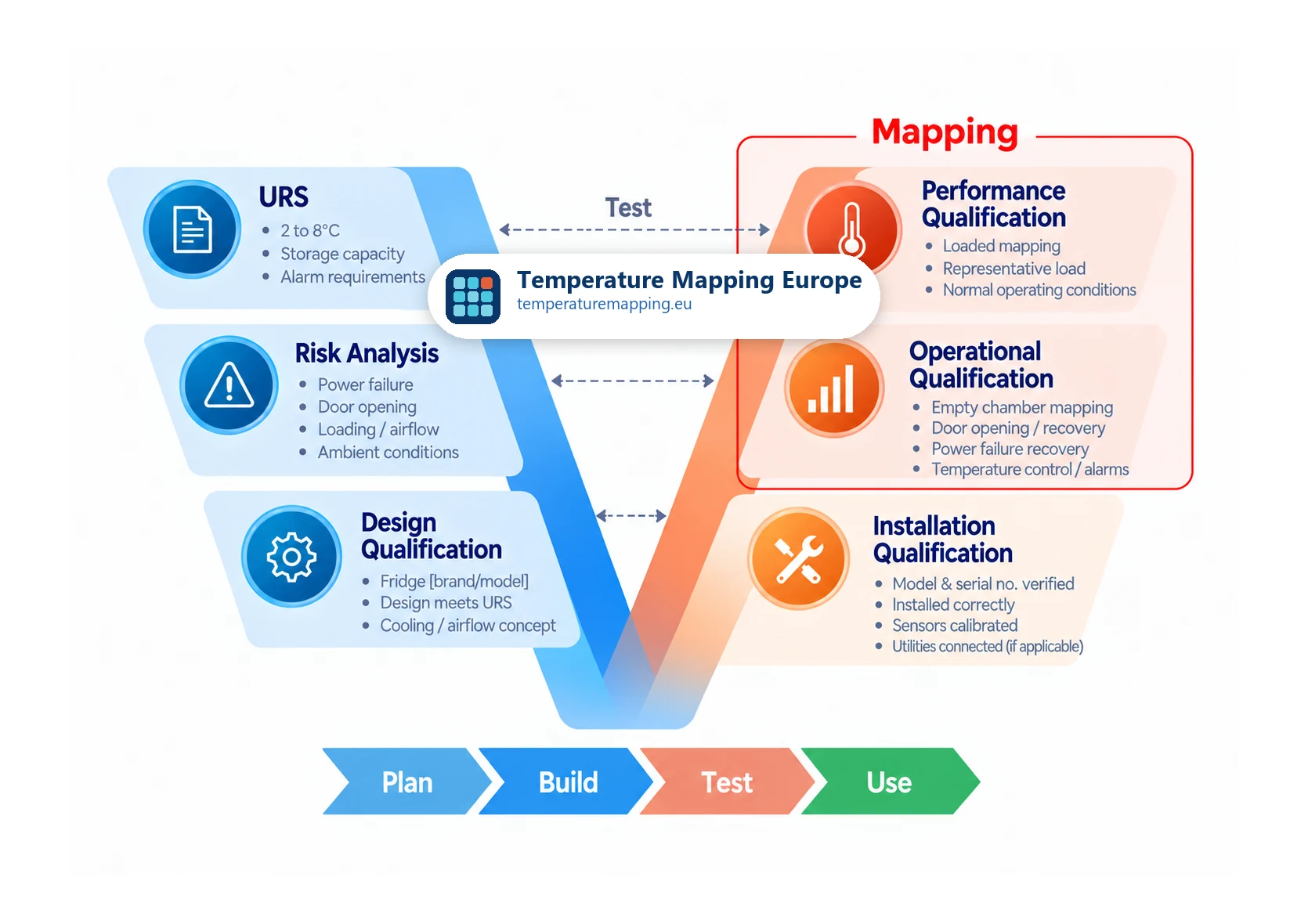
Before we walk through the V-model, a compact glossary of the six terms it contains.
| Abbreviation | Full name | Purpose |
|---|---|---|
| URS | User Requirements Specification | Defines the user's functional requirements: temperature range, capacity, alarm requirements, door-opening pattern. |
| RA | Risk Analysis | Identifies what can go wrong (power failure, door opening, loading, ambient) and drives the test strategy. |
| DQ | Design Qualification | Documents that the chosen brand, model and design meet the URS and RA outcomes. |
| IQ | Installation Qualification | Verifies the chamber is installed as specified, utilities are connected, and probes are calibrated. |
| OQ | Operational Qualification | Demonstrates the empty chamber remains within specification under simulated use, including alarm, open-door and power-loss testing. |
| PQ | Performance Qualification | Demonstrates the loaded chamber remains within specification under representative real use. |
Where temperature mapping sits in the V
Mapping is not one of the letters. It is the study whose results provide evidence for two of them: OQ and PQ. In good-practice terms:
- Empty-chamber mapping during OQ, typically at least 24 hours, to characterise the equipment itself without product load interfering.
- Loaded mapping during PQ, typically at least 24 hours, under the specified load and representative operation, to show real-world performance.
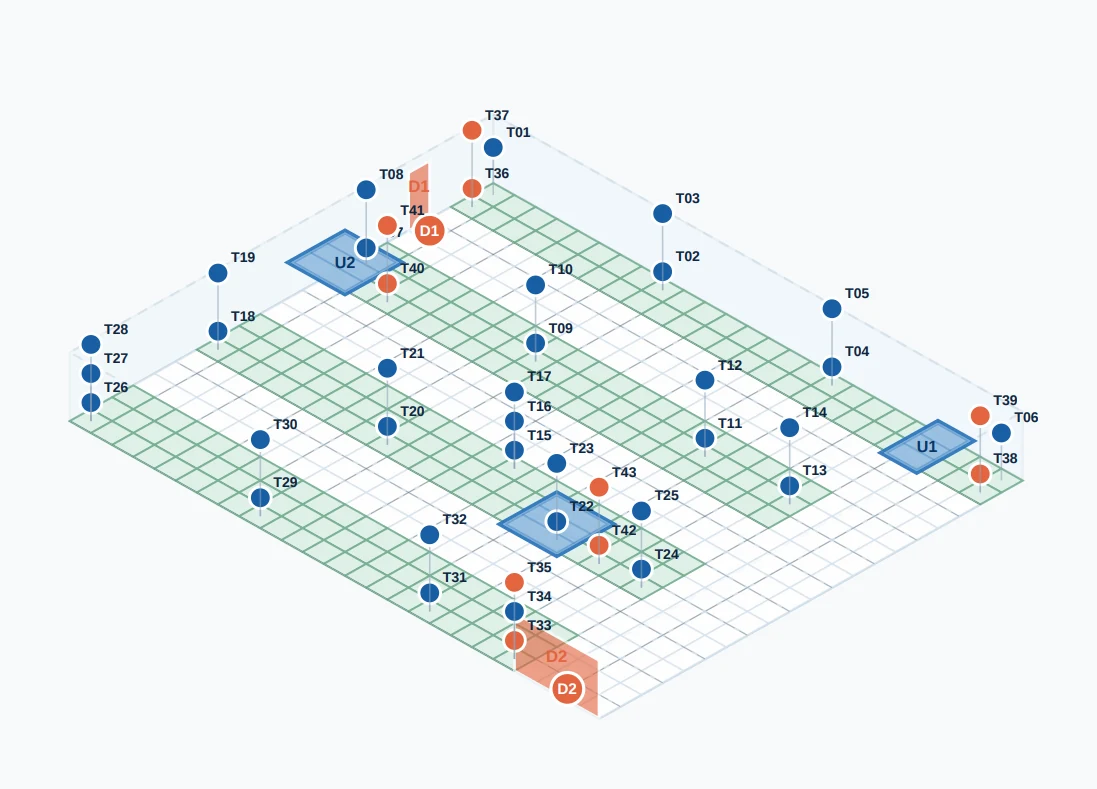
- Mapping sensor positions justified in a test strategy document, with a diagram of the placement included in the protocol.
The test strategy itself is written earlier, on the left arm of the V: it draws on the URS, DQ and RA to justify how many sensors go where, for how long and under which conditions. See where to place data loggers and how many measurement points are needed for the technical basis.
The textbook V is a useful reference, not a checklist. Two chambers with the same nominal specification can end up with very different qualification packages: one may reuse commissioning data as OQ evidence, another may run a full sequence of protocols because a change in the process demands it. Where the standard structure creates paperwork without adding assurance, we tailor the depth to the actual product risk and equipment complexity.
The left arm: URS, RA and DQ define what "good" looks like
The right arm of the V can only verify what the left arm has defined. Skip a step on the left and the corresponding test on the right has nothing to check against. That is why Annex 15 and industry good-practice guides both put so much weight on documenting the requirements up front.
User Requirements Specification (URS)
The URS defines the user's functional requirements without prescribing the technical solution. For a pharmaceutical refrigerator, that typically includes:
- Required storage temperature range (for example 2 to 8 °C for medicinal products, per 2-8 °C cold rooms and refrigerators).
- Unit capacity and the nature of the material to be stored.
- Whether pre-conditioning of the load is required (maximum load size, heating or cooling time).
- Door-opening pattern: how long and how often the door is opened.
- Environmental parameters that are critical (light, temperature, humidity).
- Alarm requirements (thresholds, notification method, escalation).
Qualification is intended to demonstrate through testing that the URS requirements have been met. Confirmation that the user requirements have been met should be traceable in the qualification documentation. If a requirement is not in the URS, no amount of testing later can prove it was intended.
Risk Analysis (RA)
Risk Analysis identifies what can go wrong and how likely and severe those failures are. For a controlled temperature chamber the recurring risks are power failure, door opening or loading events, ambient conditions and product distribution across the storage volume. The RA outputs feed the test strategy: which failure modes need active testing (open-door recovery, power-loss temperature rise), which need only monitoring, and where the highest-risk measurement points sit.
Design Qualification (DQ)
DQ documents that the chosen chamber design meets the URS and reflects the RA. For a purchased catalogue fridge, DQ can be as short as a table showing the model's specification versus the URS with matches highlighted. For a custom walk-in cold room, DQ covers the cooling capacity, airflow concept, insulation, control system and monitoring architecture.
The right arm: IQ, OQ and PQ verify what was defined
IQ: Installation Qualification
IQ is the first verification step and should confirm, at a minimum:
- A record of the major components, including model and serial numbers.
- Confirmation that calibration has been conducted as required by the specifications, for the built-in control probe and any factory-fitted sensors.
- Confirmation that the specified utilities (electrical, cooling water, drainage) are correctly connected.
IQ does not measure temperature distribution. It verifies the chamber is physically ready for OQ testing to begin.
OQ: Operational Qualification
OQ demonstrates that the system operates within its specified temperature range during simulated operation, and that the equipment behaves as expected under stress. Typical OQ tests for a controlled temperature chamber:
- Empty-chamber temperature mapping, typically at least 24 hours. Mapping sensors are placed per the test strategy document, and the protocol includes a diagram of the placement. This is the study that finds the initial hot and cold spots without the influence of product load.
- Quality-related alarm testing: temperature high, temperature low, door open, power failure, sensor fault. Alarms should activate at the correct thresholds and notify per the URS.
- Open-door recovery testing where applicable. The chamber recovers from a door-open event, and the depth and duration of the excursion are documented.
- Power-loss temperature-rise testing where applicable. The chamber loses power for a defined interval and the resulting temperature rise plus recovery time are recorded. For small equipment a formal pass or fail against a preset temperature limit is usual, but for large cold rooms and freezer rooms WHO explicitly notes that a formal pass/fail acceptance criterion is often not defined. In those cases the primary purpose of the test is to document the holdover time and the recovery time for emergency planning, rather than to serve as a pass/fail criterion for qualification.
- For liquid nitrogen or CO₂ freezers, confirmation that the fluid level is maintained at its set-point during operation.
PQ: Performance Qualification
PQ demonstrates the chamber performs consistently under real-world loading. In practice this is a loaded temperature mapping study of no less than 24 hours, with the specified load in place, run under normal operating conditions:
- The load is the load the chamber will actually hold in routine use, not merely a nominal single-box load on one shelf.
- Door-opening frequency reflects a normal working day.
- Where seasonal ambient conditions matter (particularly for GDP warehouses at 15-25 °C), the study is repeated in the worst-case season, or one season is documented as sufficient with justification.
- Data from the loaded PQ mapping determines the fixed monitoring sensor position, as covered in the hot spots and cold spots article.
COTS chambers, custom-built systems and combining stages
Commercial Off-The-Shelf (COTS) chambers (purchased catalogue fridges, freezers and incubators that arrive pre-tested from the manufacturer) usually do not need the full IQ+OQ+PQ sequence. For a COTS unit an IQ verification is often sufficient:
- Confirm the model on site matches the URS and the design specification.
- Attach the factory calibration certificate of the built-in probe and any factory-fitted sensors.
- Verify the utilities are connected as required and that the unit powers on and holds set-point.
A separate empty-chamber OQ mapping can often be limited or waived when the manufacturer supplies validated performance data for the identical model. A loaded mapping remains valuable because it shows how the unit behaves with your actual product, your door pattern and your specific location; whether that mapping is documented as PQ, as an operational verification or simply as a periodic mapping is a QA judgment call.
Custom-built systems (site-built cold rooms, walk-in freezers, warehouses, climate chambers) are the opposite case. The design, installation and commissioning include real engineering adjustments, so IQ and OQ are typically kept as separate documents and PQ is done under representative load. In practice most of these installations involve tailored work: reusing commissioning data where its quality allows, adding tests where the risk assessment demands, and skipping tests that add paper without adding assurance.
Combining stages is allowed and often sensible. Industry good-practice guidance and Annex 15 both permit IQ and OQ to be combined into a single document, and both explicitly allow qualification to reference commissioning tests that already meet the required standard. The default is not "run every stage"; the default is "produce documented evidence proportional to the risk".
The qualification documentation stack
Each stage on the V links to a document, and each document builds on the previous one. A complete qualification file for a temperature-controlled chamber typically contains:
| Stage | Document | Contains |
|---|---|---|
| URS | User Requirements Specification | Functional requirements, temperature range, capacity, alarms, door pattern. |
| RA | Risk Assessment (FMEA or similar) | Failure modes, risk scores, mitigations that drive test strategy. |
| DQ | Design Qualification report | Design matches URS, with technical drawings and specifications. |
| IQ | Installation Qualification protocol and report | Component list, calibration certificates, utility connections verified. |
| OQ | Operational Qualification protocol and report, incl. mapping protocol | Empty-chamber mapping ≥ 24 h, alarm test results, open-door and power-loss data, sensor placement diagram. |
| PQ | Performance Qualification protocol and report, incl. loaded mapping | Loaded mapping ≥ 24 h under representative load, hot/cold-spot analysis, monitoring sensor position recommendation. |
See our example mapping dossier and protocol versus report articles for how the mapping documents fit inside OQ and PQ.
Common misconceptions
- "Temperature mapping is PQ." Mapping is a study; PQ is a qualification stage. The loaded mapping produces the evidence used to support PQ.
- "IQ needs a temperature mapping." IQ verifies installation, not temperature distribution. Mapping starts in OQ.
- "We always need all three qualification stages." Combining IQ and OQ is explicitly allowed, and a separate system PQ is often not required. For a COTS pharmacy fridge, an IQ verification with a loaded mapping is often the whole file.
- "An empty-chamber mapping is enough." For custom-built systems, empty-chamber (OQ) mapping characterises the equipment; loaded (PQ) mapping characterises actual use. Both are usually needed.
- "Commissioning documentation cannot count towards qualification." Where the commissioning documentation is of an acceptable standard, it is allowed to provide evidence used in IQ or OQ, reducing duplicated testing.
- "The power-loss test has to prove the room stays in range." For small equipment, yes. For large cold rooms and freezer rooms there is often no formal temperature pass/fail; the test's purpose is to establish holdover and recovery times for emergency planning.
Sources used
- ISPE Good Practice Guide: Controlled Temperature Chamber Mapping and Monitoring, 2nd edition. Chapters 1 (Introduction), 3 (User Requirements Specification), 5 (Commissioning), 6 (Testing Strategy) and 7 (Qualification).
- ISPE Baseline Guide: Commissioning and Qualification, 2nd edition.
- EU GMP Annex 15: Qualification and Validation, sections on DQ, IQ, OQ and PQ.
- EU GDP 2013/C 343/01, chapter 3.2.1 on temperature mapping and placement of monitoring equipment at the points of greatest fluctuation.
- WHO Technical Report Series No. 961, Annex 9, Supplement 8: Temperature mapping of storage areas. Includes the observation that for large cold rooms and freezer rooms a formal pass/fail acceptance criterion for the power-failure test is often not defined; the data primarily support holdover-time and recovery-time planning.
Preparing a qualification file for an audit? Also read what auditors want to see in a temperature-mapping study and acceptance criteria and measurement uncertainty.
Draft the OQ and PQ mapping plan for your chamber
Use the 3D mapping tool to sketch the measurement-point layout for your fridge, freezer, cold room or warehouse. It gives you a first proposal for the sensor positions and count, which you can attach to your OQ or PQ protocol.
Start the 3D mapping tool