Temperature mapping and monitoring training

In one day, your team builds a solid foundation for setting up temperature mapping studies, defining acceptance criteria, implementing continuous monitoring and handling deviations. This GDP/GMP training covers the full chain: from scope, measurement points and uncertainty to alarms, calibration, data integrity, deviation handling and CAPA follow-up. Practical, audit-focused and based on your own rooms and dossiers. Delivered on site or online, in English or Dutch.

The training at a glance
  • DurationOne day, from 09:00 to 16:00, with two short breaks and a lunch break.
  • FormatAt your location, or online via a video session with shared documents.
  • Group sizeUp to 10 participants per session, with no minimum, so there is enough room for interaction and your own cases.
  • CertificateCertificate of attendance, suitable for your training records under EU GDP and GMP Chapter 2.

Why this GDP/GMP training?

Once you commission a temperature mapping study or implement a monitoring system, your organization becomes responsible for the justification behind it. In an audit, the inspector is rarely interested only in the data loggers or the software platform. The real questions are about the decisions around them: why were the sensors placed there, how were the acceptance criteria justified, and how does permanent monitoring follow from the mapping?

This training on temperature mapping and temperature monitoring brings that reasoning together in one day. You learn how to translate EU GDP and GMP Annex 15 expectations into concrete choices for your own spaces, and how to judge whether a mapping dossier or monitoring setup will stand up to inspection. The training is based on practical experience with temperature mapping, monitoring and audit questions in GDP, GMP and healthcare environments.
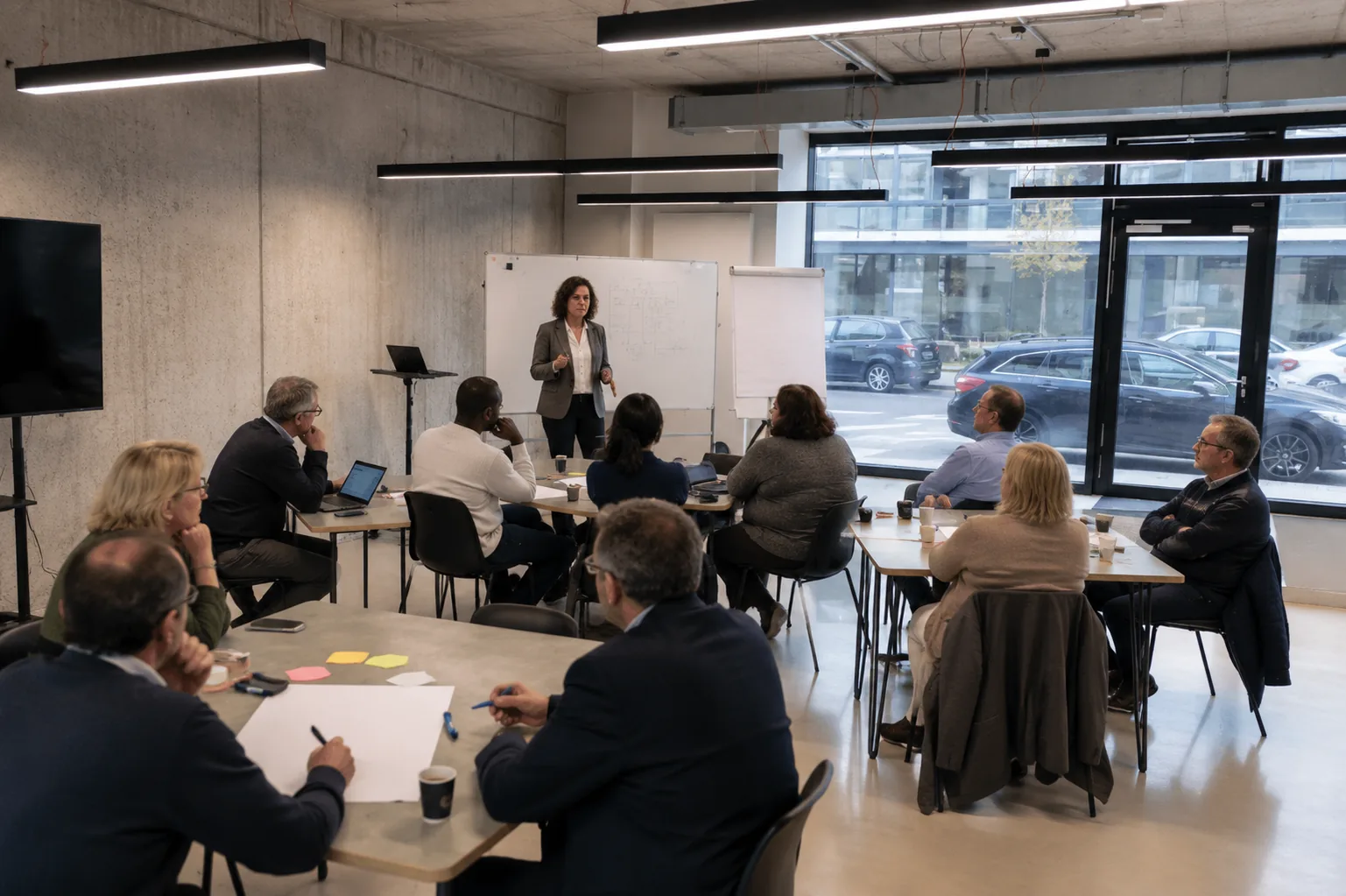
Trainer explaining temperature mapping and monitoring to a group of participants during the on-site course

Programme for the day

The schedule is a fixed framework; examples and cases are tailored to your sector and room types. In the morning we build the foundation, in the afternoon we apply it to daily practice.

Morning · Mapping foundation

From guideline to study design

  • Block 1 · Frameworks, scope and risk assessmentWhat EU GDP, GMP Annex 15, WHO and ISPE ask for, which spaces and equipment belong in scope, and how to justify the risk assessment per room.
  • BreakCoffee and a short pause.
  • Block 2 · Study design and acceptance criteriaMeasurement points, height and position, study duration and interval, acceptance criteria, measurement uncertainty and guard band. With worked examples for cold rooms, warehouses, refrigerators and ULT freezers.
  • Lunch breakA shared moment to discuss the morning content.
Afternoon · Monitoring and daily practice

From measurement to daily control

  • Block 3 · Continuous monitoring in practiceDeriving sensor position from the mapping, alarm strategy, calibration planning and ALCOA+ data integrity.
  • BreakA short pause before the final block.
  • Block 4 · Deviations, excursions and CAPAAlarm review, temperature excursions, root cause analysis and CAPA. Includes a short exercise on a real alarm log and a case discussion from your own practice.
  • Wrap-up and certificatesHandout, action list for your organization and certificates of attendance.

What you learn

By the end of the day, you can independently review a mapping setup, translate the results into continuous monitoring and explain the justification to an auditor.

Understand the frameworks

What EU GDP, GMP Annex 15, WHO and ISPE ask for by topic, and how strictly they are interpreted in practice.

Define scope

Which rooms and equipment belong inside the mapping study, and how to justify that decision after changes or renovations.

Choose measurement points

Number, height and position based on risk and airflow, with worked examples for common room and equipment types.

Set duration and interval

Why 24 hours, 72 hours or seasonal coverage may be appropriate, and which logging interval fits which objective.

Define acceptance criteria

From storage condition to guard band, MPE and alarm limit, including the measurement uncertainty of your loggers.

Interpret hot and cold spots

How to identify the warmest and coldest points, what they mean for risk, and how they guide monitoring position.

Report and handle deviations

What belongs in a mapping report, and when a deviation requires root cause analysis or CAPA.

Set up monitoring

Derive sensor position from the mapping, define alarm strategy and safeguard data integrity under ALCOA+.

Two formats: on site or online

The content is the same in both formats. The difference is the group dynamic and how directly your own spaces and dossiers can be brought into the session.

Format 01 · On site

At your location

A full training day at your site. We walk through the relevant spaces, use your equipment and dossiers as examples, and work through cases with your own situation in mind.

  • Short walkthrough of the spaces to be mapped
  • Your own protocol, report or SOP as case material
  • All participants around the same table
  • For teams that need to learn and decide together
Format 02 · Online

Via video session

Efficient for smaller or distributed teams. We work by video conference with shared documents and interactive exercises, following the same blocks as the on-site format.

  • Participants can join from multiple sites
  • Documents and exercises are shared in advance
  • Two short breaks and a lunch break
  • Can be combined with an online intake beforehand

Who is this training for?

This course is for organizations that need to not only perform temperature control, but also explain and justify it. The GDP training on temperature control is broadly applicable: from pharmaceutical storage and distribution to laboratories, healthcare facilities, pharmacies, production environments and technical teams. Prior knowledge is not required; experienced participants gain depth, practical review skills and room for their own cases.

QA, RP and quality leadswho need to review or approve mapping studies, monitoring, deviations and training records.
Technical services and facilitieswho manage refrigeration equipment, warehouses, climate chambers, rooms or building systems and are involved in measurements or alarm follow-up.
Pharma, biotech and GDP distributionfor teams safeguarding the storage conditions of medicines, APIs, materials or other temperature-sensitive products.
Healthcare, pharmacy and hospitalsfor people responsible for medicine refrigerators, ward refrigerators, medicine rooms and chilled storage in healthcare practice.
Laboratories and researchfor teams working with freezers, ULT storage, incubators, climate chambers, stability chambers or samples under GLP, GMP or internal quality agreements.
New employees and consultantswho need to get up to speed on temperature mapping, continuous monitoring, inspection expectations and practical decision-making.

What you take away

Participants leave with the handout, source references and certificate. For the organization, the day also produces a practical action list.

Per participant

Knowledge, handout and certificate

  • Handout with the topics covered and practical diagrams
  • Overview of relevant guidelines and source documents
  • Checklists for scope, measurement points and criteria
  • Certificate of attendance with date and topics
  • Worked examples for measurement uncertainty and guard banding
For your organization

Action list and practical alignment

  • Point-by-point action list from the case discussion
  • Concrete improvement points for existing dossiers
  • Advice on alignment with your quality system
  • Inputs for SOPs and work instructions
  • Follow-up questions your team can take forward

Your certificate of attendance

Every participant receives a personal certificate of attendance at the end of the course, listing the topics covered and the date. The certificate fits into your training records under EU GDP Chapter 2 or GMP Chapter 2 on personnel and training. Useful for your quality system and during inspections.
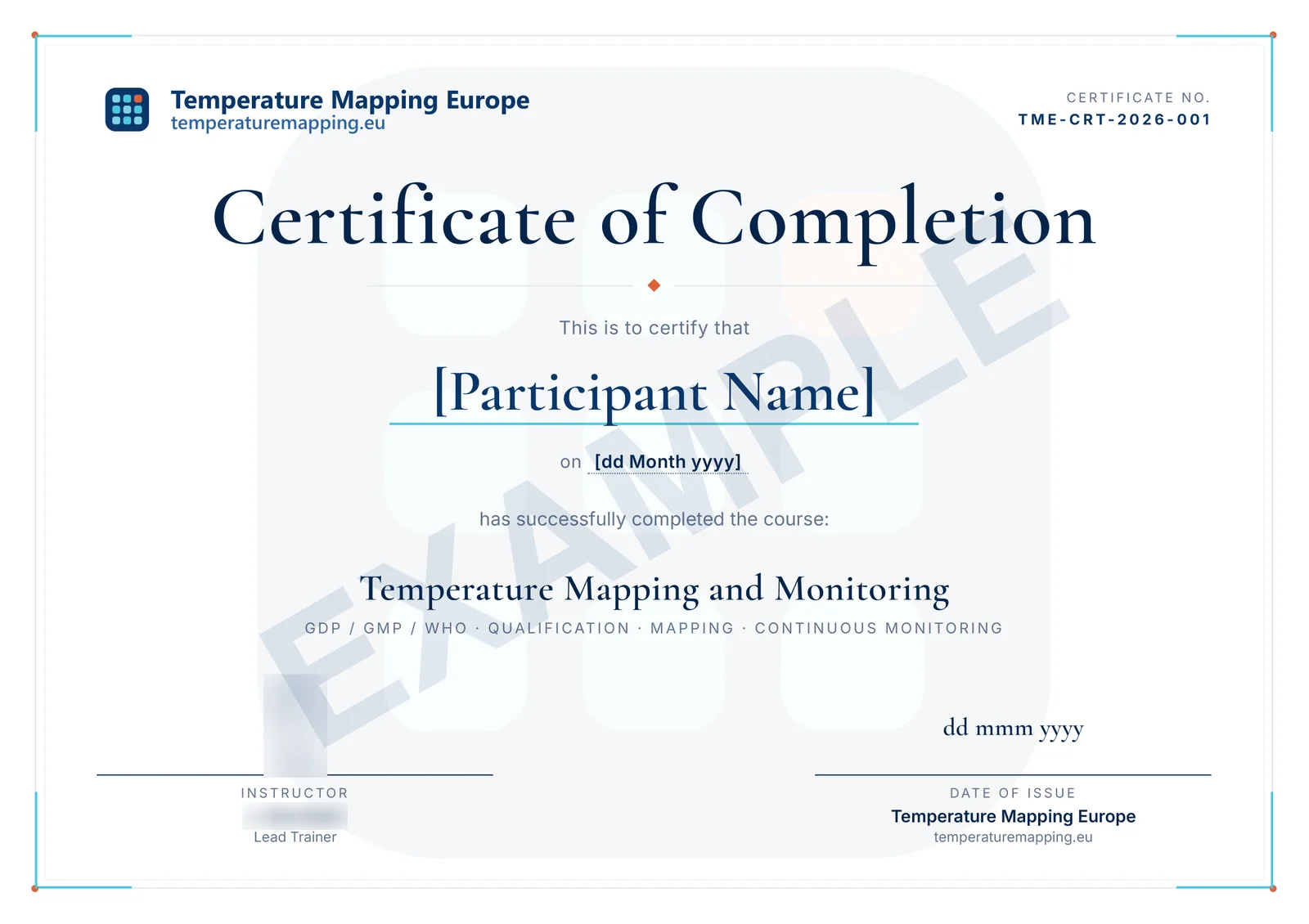
Example of the certificate of attendance for the temperature mapping and monitoring course, showing participant name, date, course name and Temperature Mapping Europe as issuer

Request a proposal for the training

Frequently asked questions about the training

About audience, content, format, group size, certification and cost. For a concrete proposal, a thirty-minute intake is enough.

Who is this training for?
For organizations that need to not only perform temperature control, but also explain and justify it. The training is broadly applicable: from pharmaceutical storage and distribution to laboratories, healthcare facilities, pharmacies, production environments and technical teams. Prior GDP or GMP knowledge is useful, but not required; experienced participants mainly gain depth, practical review skills and room for their own cases.
Which topics are covered in one day?
In the morning we cover the principles and guidelines (EU GDP, GMP Annex 15, WHO and ISPE) and the setup of a temperature mapping study: scope, risk assessment, measurement point density, study duration, acceptance criteria and measurement uncertainty. In the afternoon we move to the continuous monitoring that follows from the mapping: sensor position, alarms, calibration, data integrity, deviation handling and CAPA follow-up. We close with a case session based on your own situations.
Can the training be delivered on site or online?
Both. On site, we train at your location, with a short walkthrough of the relevant spaces and your own dossiers as examples. Online, we work through a video session with shared documents. For a team that needs to learn and decide together, on-site training usually works best; for a single participant or a distributed team, online is often more efficient.
Can the training be tailored to our sector?
Yes. The programme has a fixed structure, but the examples, cases and emphasis are tailored to your sector: GDP distribution, GMP manufacturing, pharmacy, hospital, laboratory, healthcare or research. During intake we discuss which spaces and equipment are most relevant and which guidelines carry the most weight.
Do participants receive a certificate of attendance?
Yes. Each participant receives a certificate of attendance after the training, including the topics covered, duration and date. The certificate can be used in your training records under EU GDP Chapter 2 or GMP Chapter 2 on personnel and training.
What should participants bring, and what do they receive?
Participants only need a laptop or notebook, and where possible an example from their own practice, such as a mapping study, SOP or alarm log. After the training, participants receive the handout, links to relevant guidelines, practical checklists and the certificate.
How many participants can join?
There is no minimum. Up to 10 participants can join one session, which keeps enough room for interaction and your own cases. For larger teams, we plan two sessions or split the training by role.
Which language is the training delivered in?
The training is delivered in English or Dutch. Handouts and checklists are prepared in the agreed language. For a mixed-language group, English is the default unless agreed otherwise.
Do you cover continuous monitoring and deviations, or only mapping?
All three. Temperature mapping is the starting point, but we continue into the acceptance criteria that follow from it, sensor position and alarm strategy for permanent monitoring, and the way deviations are assessed, escalated and followed up through CAPA. That connection is often where auditors ask the most detailed questions.
What does the training cost?
The price is on request because scope, location and group size vary by organization. Before booking, you receive a proposal with the programme, delivery mode, timing and price.